Claude is stealing our ability to tell stories, and that's a problem
29 October 2026
A World Without Measurecamp Is A World Without Sunshine
This past weekend, I was fortunate enough to be able to head to Sydney for Measurecamp, a marvellous event with a marvellous organisation committee, in marvellous surrounds full of marvellous people sharing marvellous ideas.
I love the energy at Measurecamp.
I love the random chats, the stumble-across of a sharp person with a sharp take on the world. I love the perma-FOMO you experience as you’ll never manage to catch every interesting thing going on, and I love the free swag, including the Supermetrics socks (let’s see if they fail randomly at the worst possible moment, just like their product does. Boom-tiss!)
There’s always a bit of a “silent theme” at Measurecamp. It’s entirely subjective, I suspect -- and dependent largely on the talks I choose to attend. In previous years there’s been themes like “the world is bigger than Google”, or “I never knew anything about Python until I started doing stuff in Python” or “agents can do my job and that’s awesome/terrifying/inevitable”.
I had a hunch that this year the theme would be less to do with the topic, and more to do with its delivery substrate.
A few days before the conference, I posted this on LinkedIn (which nobody saw, look how crappy the engagement metrics are on this site these days like why does anyone even bother etc etc):
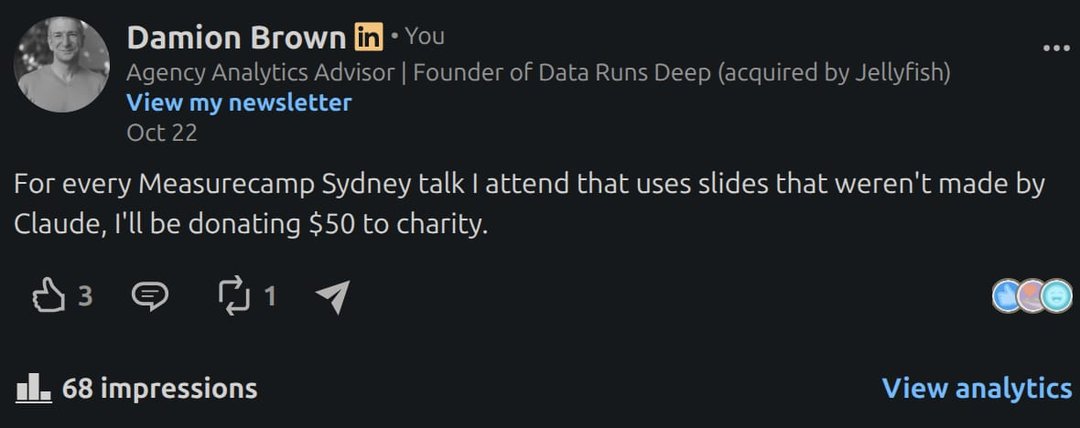
It felt as though in the last couple of months or so, every deck I’d seen was Claudified. It bore the hallmarks of being too wordy, of containing weirdly superfluous footers explaining things, of inconsistent language and headers that try to do more than be mere headers.
I saw a fair few presentations at the online Measuresummit conference earlier this month that appeared to use Claude, and several agency decks I’d been on the receiving end of were also using Claude, and I figured that a lot of Measurecamp is going to use Claude as well, and (for reasons I will explain shortly) I don’t think that’s entirely groovy.
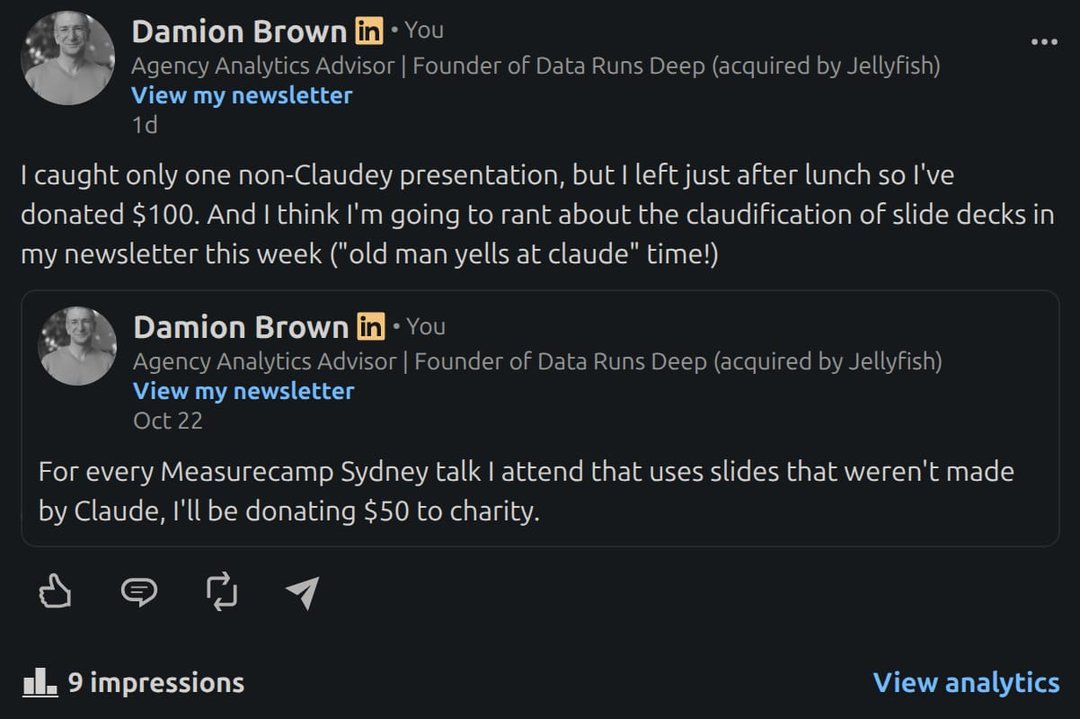
Here’s how it went:-
Yep.
I saw only one presentation that wasn’t generated by Claude, but as I left early I figured I might as well extrapolate my limited data set and assume the same frequency pattern would have occurred in the afternoon as well as the morning.
I think it’s a problem. Let me explain why.
The thing with Claude…

I didn’t use AI for this, it took me about 40 minutes using Photopea. I’m not sure if that makes me authentic, or just stupid. I will settle for being authentically stupid.
Let me say firstly: big Claude fan here.
Aside from having the sharpest personality among the commercial LLMs, I’ve found its on-the-downlow authority for technical tasks, and its ability to remember things from one moment to the next, incredibly useful in multiple aspects of my life.
(And I need to be nice to it, since once this newsletter is published I’ll be asking Claude Code to format it and push it to the repo for the newsletter archive section of my website. I love Claude because it means I’ll never need to use a CMS again.)
My problem with it comes from the way we’re over-relying on it.
Perhaps this is acutely true of the analytics industry, and it’s completely different in other industries; I don’t know, because this is the industry I know inside out and the one in which I spend lots of time talking to people.
No doubt all industries feel the pressure of Claudification, but I think our industry is sort of double-susceptible to negative disruption from Claude because of what analytics, at its core, actually is.
Does anyone know what analytics is? Bueller?
I can cast my mind back to when I first started playing with web analytics tools.
I found myself drawn in as if by an uncontrollable gravitational force: it was fascinating. I was a person, looking at numbers that were themselves codifications of the actions of other people. The act of understanding those numbers was somehow akin to unravelling a compacted set of behaviours, coaxing pattern from noise, a cosmic unscrambling of a mini SETI-project displayed on the monitor in front of me.
I also loved how web analytics seemed to require both right-brain and left-brain thinking. Successful analysis involves a certain degree of technical knowledge, around which you cast multiple possibilities and hypotheses, drawing on your lived and understood experience of human behaviour to land on a conclusion.
The “analytical” part of analytics is an important ingredient, but it’s just an ingredient.
The best analysts I’ve worked with have been absurdly creative people, opening their brains to multiple different possibilities before the actual edifying “analysis” even starts.
Analytics, then, is a complex discipline that involves both cerebral hemispheres, and I don’t doubt that this forms a lot of the attraction for a certain type of person.
(I don’t think it’s a coincidence, for instance, that I can speak with the founder of an analytics agency and find a vast amount in common with them -- not just in terms of our chosen career paths, but in how our brains work. Whether there is overlap between neurodiversity and analytics entrepreneurship, I cannot say.)
In agencies and consultancies, this “left-and-right hemisphere” thing manifests itself slightly differently.
Here’s a very crude illustration of something I’ve been kicking around for many years now -- the “axis of analytics”, with analysis / storytelling at one end and implementation at the other:
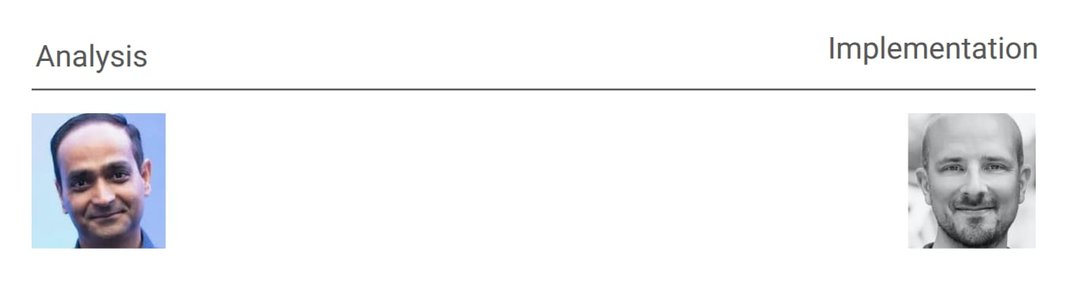
the axis of analytics. awesome, isn’t it.
A lot of agency-side teams will follow a similar pattern:
- you have a solid Implementation person, looking after the tagging and debugging and owning the data architecture.
- then you have a solid Analysis person, who’s the data Storyteller that gets clients engaged and excited, translates the work of the Implementation team into something commercial and business-y, and talks the language of the C-Level in a way that the Implementation person can’t (likely because they’re simply not interested in it!)
If you think about your analytics team, or others you’ve worked on in the past, I suspect you can envisage who sits where on that axis.
(Tangent: analytics businesses that never seem to get past implementation work may be too skewed to the right of this axis.)
It’s true that many of us won’t sit at a polar extremity, many of us float in the middle (I suspect founders, and solo freelance consultants, are within a few pixels of the middle); and I should firmly clarify that I’m not suggesting Simo can’t run a compelling analysis (I’m sure as shit he could, but then I’ve also had times when I’ve been convinced that he can leap a tall building in a single bound, so I’m not sure how empirically distant I can be on this). Likewise, I cannot and will not maintain that Avinash couldn’t debug a GTM Container on a heavily-iFrame’d single page application. We live in a world where cats on YouTube play the piano, so I’m not going to be drawn into saying something is impossible.
The photos are, of course, figureheads. My point is, a successful analytics agency will likely need to have people from both the Implementation end, and from the Analysis end.
So where does Claude come into this?
Here comes a generalisation.
You are probably already using Claude to do a lot of the work that has historically been done by individuals weighted to the Implementation end of the axis.
I’m thinking things like:
- dataLayer design specs
- QA and testing
- GTM container setup and configuration
- analytics audits
- developer documentation
- handover documentation
- data pipeline architecture
If I may assume that you’re a business owner that generally exhibits a philia or moving towards (as opposed to a phobia or moving away from) for technology, I will therefore further assume that you feel a certain amount of excitement about using this technology, coupled with a sense that there’s a commercial upside to doing so.
In other words, you’re excited to work with AI because it’s AI, but also because it allows you to deliver services more profitably, and/or at a lower cost to clients, therefore making your offering more commercially appealing.
So for this reason, I would then further assume that you’re encouraging your team to use Claude to find ways of executing this type of work more quickly, more effectively, and more consistently. You might not want Claude to replace your team, but you sure as sh*t want Claude to augment them.
Good on you, by the way -- that’s definitely the correct play, and anyone not doing that is already in the process of being left behind.
But slow down, because pushing this augmentation on your analysis & storytelling people might be counterproductive.
The very real danger of augmenting that which should not be augmented
The technical, implementation side of things lends itself very well indeed to Claudification. It needs consistency, it needs technical understanding, it needs attention to detail, and these are all things that can be accomplished by a machine intelligence that’s read literally all of stackoverflow.
The analysis & storytelling side of analytics is different.
And, in my opinion, the analysis & storytelling side doesn’t lend itself well to Claudification at all.
If you think about how the analysis & storytelling function works within an agency, it usually involves someone getting their head wrapped around something, then codifying it and putting it into their own words.
The people that are great at doing this, the “effective communicators”, are simply those that are best at:
- understanding something
- codifying it into a deck
- talking about that deck in a way that connects well with a recipient
I’ve said before that as an industry, we have too many Simos and not enough Avinashes. It’s a phrase I threaten to put on a bumper sticker, but I think it describes how we’ve learned to value the implementation side of the business more than we value the storytelling side of the business.
Yet when you look at the shape of “yer average” analytics consultancy, I wonder whether more value is actually placed by those outside the business on the storytelling side, than on the implementation side.
→ if several agencies are pitching the same client, the winner is usually whoever has the best storyteller, because they present the agency and the work in the most engaging way
→ if a client loves working with you, it’s probably because they love the way you and your team talk about the work, more than the technical accuracy of the work itself, or your proprietary testing methodology, etc.
And the Measurecamp problem? Claudified slide decks seemed to be decoupled from the message that the speaker intended, which led to a confused audience and a message that wasn’t as punchily delivered as it could have been.
You lose your edge the second you lose your individuality
My problem, then, is how Claude might insert itself in these particular parts of the process:

For that process to work well, your Analyst / Storyteller must do this themselves.
Not Claude!
The deck they produce must be a reflection of them, not their AI tool. (And “make this sound more like me” is not the right solution here either!)
We have all encountered that wonderful thing when you’re not sure whether you’ve fully grasped a concept until such time as you explain it to someone else.
I can well remember this from my university days, almost being flabbergasted that the explanation I gave someone was coherent, reasonably accurate, and even possibly useful. I believe that if you want to be authentic in business, you need to speak authentically about something you properly, and fully, understand.
If you’re asking your analysis and storytelling people to use Claude, you’re denying them the ability to truly understand something in the same way. You’re effectively denying them the opportunity to do what they’re good at doing.
If you are instructing them to use Claude, you’re removing their individuality from the finished product.
I’d encourage you to look at it this way:
- If they use Claude to produce their Slides, they’re not using that critical part of their brain that allows them to fully understand something
- If they don’t fully understand something, they can’t speak about it to clients with authentic conviction and confidence
- If your clients aren’t being spoken to with authentic conviction, that undermines their overall confidence in your agency
- That’s not often a problem you hear about until it’s too late (i.e. contract renewal)
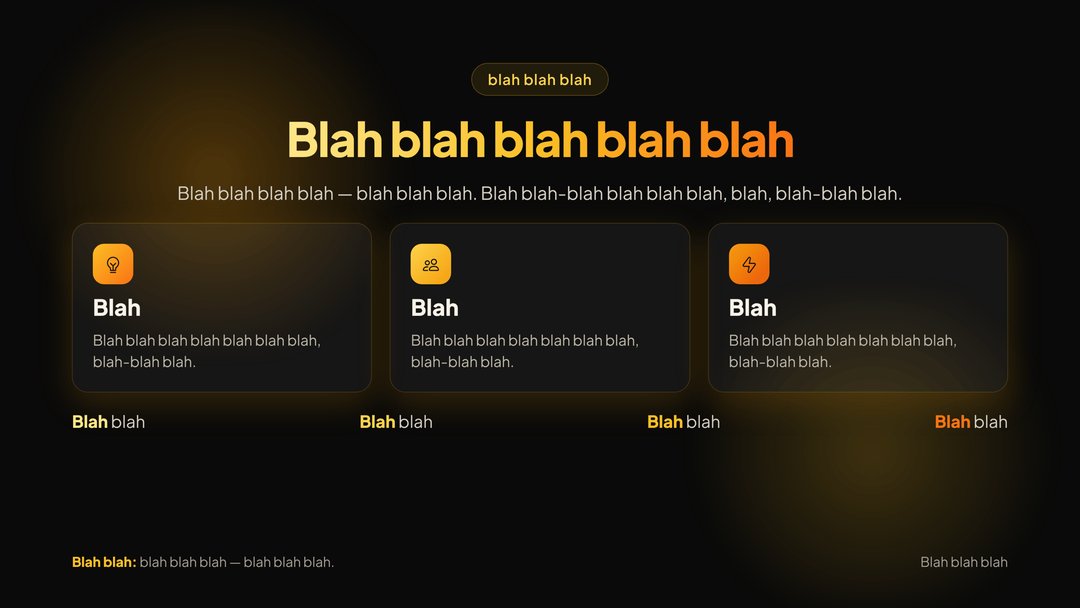
Please, kill me now. (Made with AI).
I think it’s dangerous to encourage the storytellers to use Claude for this.
Your implementation team: yes, get them AI native (or whatever the buzzword is at the time you’re reading this) as quickly as you can. Streamline delivery, increase efficiency, increase accuracy. That’s a win.
Your analytics and storytelling team: slow down. Please don’t encourage them to adopt AI for client-facing storytelling stuff, because that’s what gives them an individual voice, and it’s what gives your agency its reputation, far more than a lean GTM container template or a library of API whatnots will ever do.
Clients aren’t stupid* -- they can tell when a slide is AI generated. The excess text, the footers explaining something that doesn’t need explaining, the muted-yellow-on-black that’s a disaster for anyone sat at the rear of a Measurecamp talk.
Don’t devalue your message by homogenisation, especially when you’ve worked so hard to bring it to life.
But hey, enough of my yakkin’. I’ll catch you next time!
Thanks for reading. No AI was used in the creation of the words you just read.
I do this for a living. I work with agencies and consultancies around the world, providing the support I wish I’d had throughout my journey of starting, scaling, and selling an agency.
If you think you could benefit from what I know how to do, I welcome conversation: hit reply.
On this site, you’ll also find information about the Analytics Consultants Circle, a free monthly peer-group call that I moderate, where solo and small-team consultants share battle stories from the field, and we talk about the challenges you face when you grow and scale a business.
The last movie I watched: Wayne’s World (1992), which I think might be one of the best examples of consistently brilliant comedic timing in cinematic history (no, really!)
* some are
The Business of Analytics lands fortnightly. If this one was useful, the next one probably will be too.
Subscribe ↗